Finding authentic ancient Japanese last names can be hard. Many lists mix modern surnames with historic ones and skip the meanings. That makes it difficult to pick a name that truly feels old and real.
This guide fixes that. Every name below comes from Japan’s court, clan, samurai, or village history. You will find the kanji meaning and a short note for each one.
Here you will find 200 ancient Japanese last names, grouped by class, era, nature, and region.
What Makes a Japanese Surname Ancient?
Most Japanese people had no family name until 1875. Before that, only nobles, warriors, and some wealthy families used surnames.
Ancient Japanese last names usually came from three sources: clan titles, place names, and land features. A name is often called ancient when it appears in records before the Edo period.
Many of these names are still used today, which keeps their history alive.
10 Notable Ancient Japanese Surnames at a Glance
These ancient Japanese last names shaped court life and early Japanese history. Start here for the most recognized family names.
| Name | Meaning | Origin |
| Fujiwara | Wisteria field | Heian court noble clan |
| Minamoto | Source, origin | Imperial-descended Genji clan |
| Taira | Peace | Heike warrior clan |
| Tachibana | Mandarin orange | Granted by the imperial court |
| Sugawara | Sedge field | Scholar clan of the Heian era |
| Otomo | Great companion | Ancient warrior clan |
- Mononobe – clan of the warriors who served the early court
- Nakatomi – “middle minister,” an ancient priestly clan
- Hata – “loom,” a family of skilled weavers
- Kamo – “duck,” tied to old Kyoto shrines
The Origins and Historical Development of Japanese Family Names
Japanese surnames grew from land, jobs, and geography. These ancient Japanese last names show how people described where they lived.
- Yamamoto – base of the mountain
- Tanaka – middle of the rice field
- Watanabe – area around the river crossing
- Ito – wisteria of Ise province
- Suzuki – bell tree, linked to Kumano shrines
- Takahashi – tall bridge
- Sato – helper wisteria, a Fujiwara branch
- Nakamura – middle village
- Kobayashi – small woods
- Kato – added wisteria, from Kaga province
- Yoshida – lucky rice field
- Yamada – mountain rice field
Japanese Surnames Associated With the Samurai Class
Warrior families made some of the most famous ancient Japanese last names. Many belonged to daimyo who ruled whole regions. For darker, battle-linked naming ideas, see these Japanese names that mean death.
- Oda – small field
- Toyotomi – abundant minister
- Tokugawa – virtuous river
- Takeda – warrior field
- Uesugi – upper cedar
- Date – named for the Date district, also means stylish
- Hojo – northern strip
- Shimazu – island harbor
- Hattori – clothing group, famous for spies
- Sanada – true field
- Maeda – front field
- Hosokawa – narrow river
- Kuroda – black field
- Asakura – morning storehouse
- Imagawa – present river
- Akechi – bright wisdom
- Ishida – stone field
- Honda – root field
- Ii – well
- Mogami – uppermost river
- Todo – wisteria hall
- Matsudaira – pine peace
- Yagyu – willow birth, known for sword schools
- Miyamoto – shrine base
Family Surnames From Japan’s Feudal Period
Feudal Japan produced many regional houses. These ancient Japanese last names often point to a castle town or province.
- Hatakeyama – field and mountain
- Ogasawara – small hat plain
- Ouchi – great inner area
- Rokkaku – six corners
- Azai – shallow well
- Nagao – long tail
- Satake – helper bamboo
- Chiba – thousand leaves
- Kikuchi – chrysanthemum pond
- Soma – named for Soma district
- Nambu – southern region
- Nitta – new field
- Isshiki – one color
- Akamatsu – red pine
- Yamana – mountain name
- Kyogoku – edge of the capital
- Utsunomiya – named for a shrine city
- Yuki – binding castle
- Oyama – little mountain
- Shibata – brushwood field
Ancient Japanese Clan Names and Their Heritage
Clan names are the oldest ancient Japanese last names. They trace back to the Yamato court and its early rulers.
| Name | Meaning | Origin |
| Inbe | Ritual purification clan | Ancient Yamato court |
| Soga | Powerful Yamato clan name | Asuka period |
| Kume | Warrior band | Early imperial guard |
| Haji | Clay masters | Tomb craftsmen of old Japan |
| Katsuragi | Vine castle | Yamato region clan |
| Kibi | Region name, Okayama area | Ancient Kibi realm |
- Yamato – great harmony, the ancient heartland
- Izumo – emerging clouds, home of a famed shrine
- Wani – early court clan tied to scholars
- Heguri – ancient Yamato clan
- Koma – from Goguryeo, Korean descent
- Munakata – Kyushu shrine clan
- Aso – named for Mount Aso
- Owari – province name
- Sakanoue – upper slope, famed generals
- Kudara – from Baekje, Korean descent
- Nakahara – middle plain
- Kiyohara – pure field
- Oe – great inlet
- Ono – small field
- Miyoshi – three goods
- Hasebe – long valley section
Traditional Japanese Surnames Inspired by Nature
Nature gave Japan some of its most beautiful ancient Japanese last names. Trees, rivers, and mountains appear again and again. If you like elemental surnames, you can also browse last names that mean fire.
- Hayashi – woods
- Matsumoto – pine base
- Sakurai – cherry well
- Kawaguchi – river mouth
- Ishikawa – stone river
- Ogawa – small river
- Yanagi – willow
- Shimizu – clear water
- Kiyomizu – pure water
- Morita – forest rice field
- Hoshino – star field
- Umeda – plum field
- Kusunoki – camphor tree
- Sugiyama – cedar mountain
- Aoki – green tree
- Mizuno – water field
- Iwasaki – rock cape
- Nomura – field village
- Shirakawa – white river
- Akiyama – autumn mountain
- Fuji – wisteria
- Takeuchi – inside the bamboo
- Tsukioka – moon hill
- Kazama – wind gap
- Harada – meadow field
Rare and Lesser-Known Japanese Surnames From History
Some ancient Japanese last names are rarely heard today. Most belonged to Kyoto court families and are named after city streets and gates. If you want more uncommon picks, our list of rare Japanese last names has many more.
- Ichijo – first avenue
- Nijo – second avenue
- Sanjo – third avenue
- Kujo – ninth avenue
- Gojo – fifth avenue
- Konoe – imperial guard
- Takatsukasa – falcon office
- Saionji – western garden temple
- Reizei – cold spring
- Tsuchimikado – earthen gate
- Karasuma – crow circle
- Asukai – Asuka well
- Hino – sun field
- Kazanin – flower mountain residence
- Madenokoji – a Kyoto lane name
- Anegakoji – elder sister lane
- Ayanokoji – twill lane
- Takakura – high storehouse
Historic Japanese Family Names Still Used Today
Many ancient Japanese last names survived and are common now. These families have carried the same names for centuries.
- Kimura – tree village
- Saito – purification wisteria
- Inoue – above the well
- Hashimoto – bridge base
- Ishii – stone well
- Fujita – wisteria field
- Okada – hill field
- Goto – later wisteria
- Hasegawa – long valley river
- Murakami – upper village
- Endo – distant wisteria
- Nakajima – middle island
- Kaneko – gold child
- Fukuda – fortune field
- Ota – thick, fertile field
How Japanese Surnames Evolved Through Different Eras
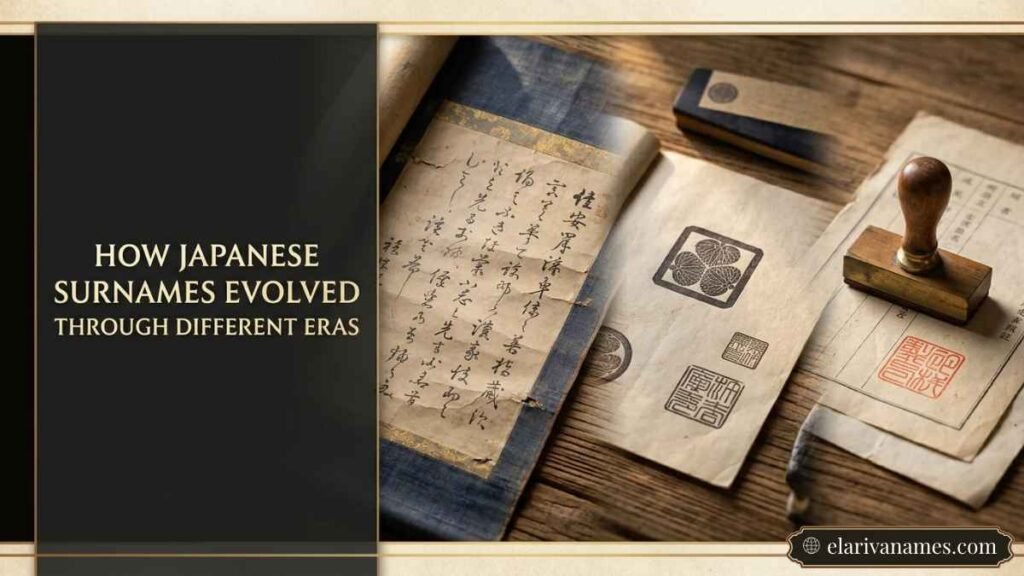
Surnames changed with each period of Japanese history. The table shows how ancient Japanese last names grew from clans to commoner names.
| Era | Surname Type | Best Known For |
| Asuka and Nara | Clan titles | Court roles |
| Heian | Noble house names | Aristocrats |
| Kamakura to Sengoku | Warrior names | Samurai lords |
| Meiji onward | Commoner names | Every family |
- Abe – an old clan name, kanji vary
- Sakamoto – slope base
- Kondo – near wisteria
- Miura – three bays
- Yokoyama – side mountain
- Tsuchiya – earth house
- Arai – new well
- Nagai – long well
- Kojima – small island
- Takagi – tall tree
Ancient Japanese Surnames and Their Traditional Meanings
Kanji carry the meaning of ancient Japanese last names. Most combine two simple ideas, such as a place and a land feature.
- Nishida – western field
- Ueda – top of the rice field
- Maruyama – round mountain
- Sugimoto – cedar base
- Nakagawa – middle river
- Inagaki – rice fence
- Tomita – wealthy field
- Kuwabara – mulberry field
- Hirano – flat field
- Takai – high well
- Noguchi – field entrance
- Yasuda – peaceful field
- Okamoto – hill base
- Tamura – rice field village
Historic Japanese Surnames From Different Regions of Japan
Each region has its own ancient Japanese last names. Kyushu, Okinawa, and Tohoku all kept distinct naming styles.
- Nabeshima – pot island
- Ryuzoji – dragon-works temple
- Higa – Okinawan village name
- Shimabukuro – island bag
- Kinjo – gold castle
- Arakaki – new fence
- Uehara – upper field
- Miyazato – shrine village
- Tsugaru – named for the Tsugaru region
- Ando – peaceful wisteria
- Kikkawa – lucky river
- Kobayakawa – small early river
- Amago – nun child
- Chosokabe – the lords of Tosa
- Kono – river field
- Kuki – nine demons
- Hida – ancient province name
- Kamei – turtle well
- Matsuura – pine bay
- Shimada – island field
Famous Japanese Family Names With Historical Significance
These ancient Japanese last names belong to leaders and fighters who changed Japan. Their names still carry weight today.
- Saigo – west village
- Okubo – great hollow
- Kido – wooden gate
- Yamagata – mountain shape
- Iwakura – rock storehouse
- Itagaki – board fence
- Katsu – victory
- Takasugi – tall cedar
- Hijikata – earth direction
- Okita – offshore field
Tips for Understanding and Choosing an Ancient Japanese Surname
Picking from ancient Japanese last names is easier with a few simple checks. Use these tips for fiction, research, or family history. Need a full name to go with your surname? Try our Japanese name generator.
- Check the kanji, since the same sound can have different meanings.
- Match the name to the era and social class you need.
- Read the name aloud to confirm it sounds natural.
- Choose clan names for nobles and place names for villagers.
- Avoid mixing court names with commoner names in one story.
Frequently Asked Questions
What are the oldest ancient Japanese last names?
Clan names like Soga, Mononobe, and Otomo are among the oldest in Japanese records.
Did ordinary people have last names in ancient Japan?
Most commoners had no surname until 1875, when the Meiji government required one.
Can I use ancient Japanese last names in a novel?
Yes, just match the name to the era and social class of your character.
Why does my chosen Japanese surname have several meanings?
Different kanji can share one sound, so always check the written characters.
Are ancient Japanese last names still in use?
Yes, names like Fujiwara, Tachibana, and Sakamoto are still carried by families today.
Conclusion
Ancient Japanese last names carry the story of clans, castles, and villages. From Fujiwara to Okita, each one reflects land, power, or tradition.
This list gives you 200 historic surnames with clear meanings. Use them for writing, research, or learning about Japanese culture.
Pick the ancient Japanese last names that speak to you, and enjoy the history behind them.

Dur e Nayab is the writer behind Elariva Names, sharing meaningful names, their origins, meanings, and naming inspiration to help readers discover names they truly love.